The Hobbies Nobody's Posting About Are the Ones Actually Making People Happy
I picked up bird-watching last spring. Not the serious, binoculars-around-your-neck kind — just a cheap field guide, a spot in Prospect Park, and thirty minutes on a Tuesday morning where I sat on a bench and watched birds do bird things.
I never posted about it. Not once. And for someone who shares a lot of her life online, that felt kind of radical.
But here's the thing: those thirty minutes were some of the most genuinely peaceful I'd had in months. And I think the fact that I wasn't documenting them was at least part of why.
The Content-ification of Everything
At some point — and I don't think any of us consciously decided this — hobbies became content. Baking became aesthetic flat lays of sourdough. Running became Strava screenshots and carefully captioned race-day photos. Even reading, which is about as private an activity as it gets, turned into BookTok reviews and Goodreads stats shared with strangers.
None of that is inherently bad. Sharing things you love is a genuinely human impulse. But somewhere along the way, a weird inversion happened: instead of sharing because we loved something, a lot of us started doing things in order to share them. The activity became secondary to the content it could produce.
And that shift? It changes the experience completely.
Psychologists who study motivation talk about the difference between intrinsic and extrinsic motivation — doing something for the pure pleasure of it versus doing it for external reward or validation. Research consistently shows that when you introduce extrinsic rewards (likes, comments, social approval) into something you were previously doing for intrinsic reasons, the internal enjoyment often decreases. It's called the overjustification effect, and it's basically what happens when your hobby becomes your content.
What a "Quiet Hobby" Actually Looks Like
So what are we talking about when we say quiet hobbies? Not necessarily anything unusual. In fact, a lot of them are pretty ordinary — which is kind of the point.
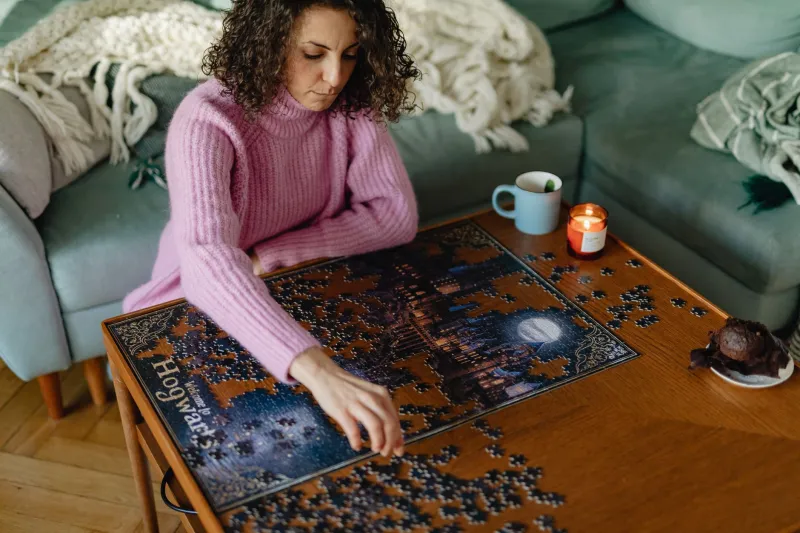
Think: jigsaw puzzles done alone on a Saturday afternoon. Tending a small herb garden on your apartment windowsill. Keeping a handwritten journal that you never turn into a YouTube series. Learning to identify wildflowers on your local hiking trail. Playing piano in your living room for an audience of exactly zero.
The defining quality isn't the activity itself — it's the intention behind it. A quiet hobby is something you do entirely for yourself. No audience. No performance. No mental calculation about whether it would make a good reel.
And increasingly, people are seeking these out deliberately.
Why Gen Z Is Leading This Shift
It might seem counterintuitive that the generation most associated with social media fluency is also the one most visibly pulling back from performative hobbies. But it actually makes a lot of sense.
Gen Z didn't just grow up with social media — they grew up with the pressure of social media in a way older generations didn't. Many of them watched peers build personal brands in their teens, saw the anxiety that came with follower counts and engagement metrics, and burned out on the whole thing before they hit their mid-twenties.
There's a reason searches for things like "offline hobbies," "analog activities," and "hobbies without screens" have been steadily climbing on Google. People are actively looking for activities that exist outside the digital ecosystem. Not because they're anti-technology, but because they're craving experiences that belong entirely to them.
I've talked to people in their twenties who are getting into things like hand-lettering, tabletop role-playing games, foraging, amateur astronomy, and embroidery — and the consistent thread isn't just that these activities are enjoyable. It's that they feel private. Contained. Real in a way that a lot of online experience doesn't.
The Pressure to Make It a "Thing"
Here's what I've noticed in my own life: the moment I get good at something, there's an almost automatic impulse to share it. And right behind that impulse is a slightly more insidious one — to monetize it. To turn it into a side hustle, a channel, a niche.
Our culture is obsessed with productivity and ROI in a way that makes it genuinely difficult to do something just because it feels good. Somewhere along the line we absorbed the idea that time spent on something that doesn't produce an output — financial, social, content-related — is time wasted.
But that framing is exhausting. And I think a lot of people are starting to push back on it.
A hobby doesn't have to become a brand. It doesn't have to scale. It doesn't have to be optimized or monetized or aestheticized for public consumption. Sometimes the most valuable thing a hobby can do is give you an hour where you're completely absorbed in something that has nothing to do with your productivity or your image.
That's not wasted time. That's actually kind of essential.
What Happens When You Try It
I want to be honest: the first few times I sat in the park with my field guide, I felt a little restless. My brain kept nudging me — this would make a cute post, though. The compulsion to document is real and it doesn't disappear overnight.
But after a few sessions, something shifted. I started noticing more. The specific way a red-tailed hawk holds its wings in a thermal. The sound a mockingbird makes when it's doing its impression of a car alarm. Small things that I would have completely missed if I'd been trying to frame them for a photo.
That's the gift of undocumented experience: you're actually in it. Not performing it. Not curating it. Just having it.
And weirdly, those moments feel more like mine than almost anything I've ever shared online.
A Few Quiet Hobbies Worth Trying
If you're curious about this and want to experiment, here are some starting points that require almost no equipment and zero audience:
- Sketching — not to get good at it, just to look at things more carefully
- Birdwatching — genuinely free, surprisingly absorbing
- Hand journaling — pen and paper, no apps, no prompts required
- Foraging walks — learn one plant a week in your local area
- Jigsaw puzzles — deeply unfashionable, deeply satisfying
- Learning a card game — solitaire counts, and so does teaching yourself poker
- Cooking a cuisine you know nothing about — no blog post required
None of these need to become a personality. None of them need to be shared. They can just be yours.
And in a world where everything feels like it's competing for an audience, having something that belongs entirely to you might be the most quietly radical thing you can do.